When to Issue a Self-Billed e-Invoice

As Malaysia pivots toward a fully digital tax ecosystem, the “Self-Billed e-Invoice” has become a major talking point. A common misconception is that you must self-bill every time a supplier fails to provide an e-Invoice.

The reality? It’s not a catch-all solution.

According to LHDN (Inland Revenue Board of Malaysia) guidelines, self-billing is mandatory only for specific transactions classified as “Special Payments.” Before you hit “submit” on a self-billed invoice, check if your transaction falls into one of these nine categories.


The 9 Scenarios for Mandatory Self-Billed e-Invoices

1. Incentives, Commissions, and Rebates

If you are paying incentives or commissions to agents, dealers, or distributors, the responsibility for the e-Invoice falls on you (the payer), not the recipient.

2. Importation of Goods and Services

When dealing with foreign suppliers, they aren’t part of the LHDN MyInvois system. Therefore, to claim your input tax or business expense, you must issue a self-billed e-Invoice for all imported goods and services.

3. Profit Distribution (Dividends)

While dividends from companies (like a Sdn Bhd or Bhd) are currently exempt, other forms of profit distribution to partners or investors require a self-billed e-Invoice.

4. E-Commerce Platform Fees

If you sell on platforms like Shopee or Lazada, the fees and charges deducted by the platform are considered Special Payments. You must self-invoice these costs.

5. Lottery and Gaming Winnings

Licensed gaming operators must issue self-billed e-Invoices when paying out prizes or winnings to lucky winners.

6. Payments to Private Individuals

This is a common one for SMEs. If you pay an individual who is not conducting a registered business, you must self-bill.

  • Examples: Rent paid to a private landlord, or a referral fee paid to a friend/employee.

7. Interest Payments

If you are paying interest to an individual or another company (e.g., a private loan), you must self-bill.

Note: Payments to licensed financial institutions (Banks) are the exception—the bank will issue the e-Invoice to you.

8. Insurance Claims and Payouts

Insurance companies are required to issue self-billed e-Invoices whenever they make a claim payout to a policyholder, whether the recipient is an individual or a business.

9. Capital Reduction and Share Buybacks

When a company returns capital to its shareholders—either through a formal capital reduction exercise or by buying back its own shares—this is classified as a Special Payment requiring a self-billed e-Invoice.


The table below outlines the updated scenarios and the respective roles of suppliers and buyers for self-billed e-invoices:

NoTransactionSupplierBuyer
1Payment to agents, dealers, distributors, etc.Agents, dealers, distributors, etc.Taxpayer making the payment
2Goods sold or services rendered by foreign suppliersForeign SellerMalaysian Purchaser
3Profit distribution (e.g., dividend distribution)Recipient of the distributionTaxpayer making the distribution
4E-commerce transactionsMerchants, service providersE-commerce / Intermediary platform
5Pay-out to all betting and gaming winnersRecipient of the payoutLicensed betting and gaming provider
6Acquisition of goods or services from individual taxpayers who are not conducting a businessIndividual taxpayers providing goods or servicesA person acquiring goods or services
7Interest paymentRecipient of interest paymentTaxpayer making the interest payment

Quick Reference Summary

CategoryDo you need to Self-Bill?Key Exception
Foreign SuppliersYesN/A
Agents/DealersYesGeneral employees (Payroll)
Private LandlordsYesCommercial REITs/Property Companies
Bank InterestNoThe Bank issues the invoice
Sdn Bhd DividendsNoCurrently exempt

Key Takeaway

A self-billed e-Invoice isn’t a “fix” for a lazy supplier; it is a specific regulatory requirement for these nine scenarios. Misclassifying these payments can lead to compliance headaches down the road.

IRBM extends e-Invoice transitional period for Phase 4 and allows consolidated e-Invoice for wholesalers and retailers of construction materials

The Inland Revenue Board of Malaysia (IRBM) has announced the following updates on e-Invoice implementation:

  • • Taxpayers under Phase 4 of the e-Invoice implementation will be granted a 12-month transitional period from 1 January 2026 to 31 December 2026 instead of the previously announced 6-month period.
  • • Taxpayers in the wholesale and retail construction materials industry are now allowed to issue consolidated e-Invoices effective 1 January 2026.

Following the announcement, IRBM has updated the following documents:

  • • e-Invoice Specific Guideline
  • • implementation of e-Invoice in Malaysia Frequently Asked Questions (FAQs)
  • • implementation of e-Invoice in Malaysia Frequently Asked Questions (FAQs) for construction industry.

The key highlights as follows:

  • • During the transitional period, IRBM will not impose penalties provided taxpayers comply with the following conditions:
    • – issuing consolidated e-Invoices for all activities and transactions, including those listed under section 3.7 of the e-Invoice Specific Guideline and to buyers or suppliers who specifically request an individual e-Invoice or individual self-billed e-Invoice
    • – issuing consolidated self-billed e-Invoices for all transactions outlined under section 8.3 of the e-Invoice Specific Guideline, and
    • – inputting any information or details of the transaction in the “Description of product or services” field of the consolidated e-Invoice or consolidated self-billed e-Invoice.
  • • Taxpayers in the wholesale and retail of construction materials industry are only required to issue individual e-Invoices for:
    • – transactions exceeding RM10,000, or
    • – transactions where an individual e-Invoice is specifically requested by the buyer.

Formula calculating individual dividend tax gazetted

The formula to determine the individual’s chargeable income for dividend tax has been gazetted. The new rule would apply to both tax resident and non-tax resident taxpayers and is effective year of assessment 2025 onwards.

Tax identification number search function now available on MyTax portal

Taxpayers may now search for tax identification numbers (TIN) on the MyTax portal for taxation purposes under the Income Tax Act 1967. Users can make a TIN search by entering the following information:

• identification numbers (identification card number or passport number) — for individual taxpayers

• business registration number or taxpayer’s registered name — for non-individual taxpayers.

Capital Gains Tax

Capital Gains Tax: Implementation and effects with Income Tax and RPGT

On 29 December 2023, the Finance (No.2) Act 2023 was published, and with it, the tax laws governing Capital Gains Tax (“CGT”) were formally enacted.

Who is affected?

  • Companies
  • Trust Bodies
  • Limited Liability Partnerships (LLP)
  • Co-Operative Societies

Implementation Dates

Effective dateTypes of Capital Assets Affected
1 Jan 2024Foreign Capital Assets
1 Mar 2024*•Local Unlisted Shares
•Shares Deemed Acquired in Malaysia Pursuant to Section 15C of the Income Tax Act

*The effective date has been deferred to 1 March 2024 with the gazette of Income Tax (Exemption) (No.7) Order 2023.

Types of Capital Assets subject to this CGT

  1. Local unlisted shares
  2. Section 15C
    • foreign unlisted company shares deemed acquired in Malaysia
  3. All types of foreign capital assets

CGT Tax Rates

Effective date of acquisitionTypes of Capital Assets
Affected
Malaysian unlisted company shares
acquired before 1 January 2024
10% on gain or 2% on gross
proceeds
Malaysian unlisted company shares
acquired after 1 January 2024
10% on gain
Foreign sourced capital gains i.e capital
gains from disposals of assets held outside
Malaysia and acquired at any time in the
past
Taxpayer’s prevailing tax rate

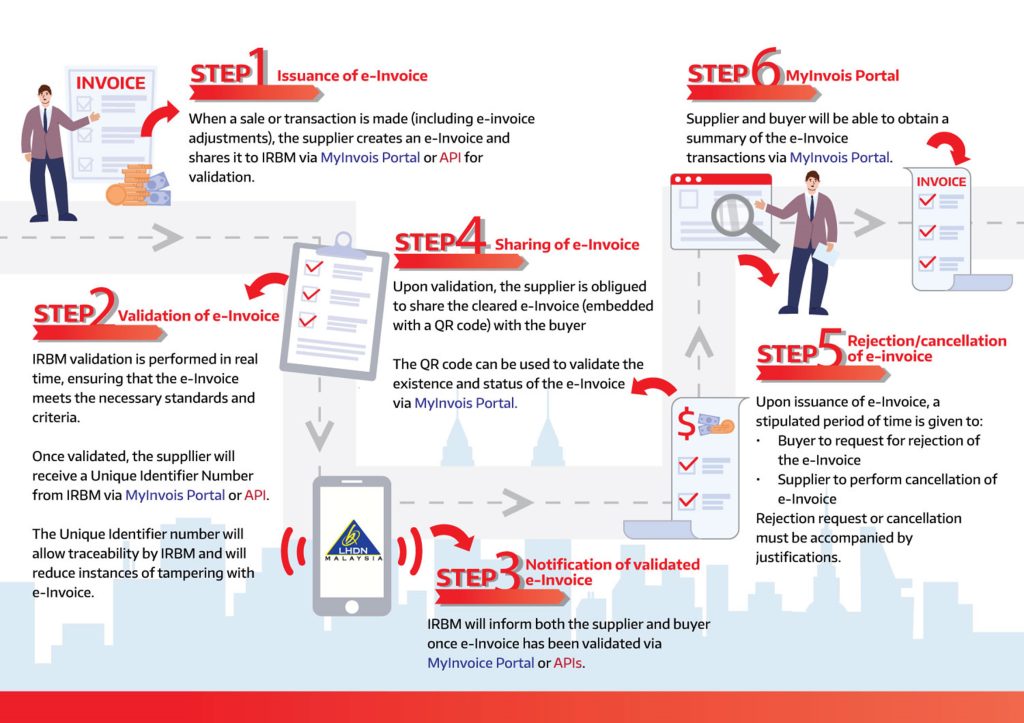
How e-Invoice actually works?

The e-invoice workflow

So how does the whole process of sending and receiving of e-Invoice is like and how long does it take for the validation process?

While it involves a series of complex procedures to ensure a safe digital transaction between supplier and buyer, most of the processes will be conducted within the system, and does not require user’s intervention, and for the validation process, according to LHDN, it will be conducted electronically, which can be done instantly or near-instantly.

Step 1: Issuance of e-Invoice.
The whole e-invoice process begins when a sale and or transaction is made (including e-invoice adjustments), which the supplier or sender create and e-Invoice to share to IRBM via Myinvoice Portal or API for validation. For accounting solution such as AutoCount, this feature is connected through API, by including e-Invoice within our system, users can have a more complete and automated invoicing process, without the need of accessing portal often to send and receive invoices.

Step 2: Validation of e-Invoice.
As the submitted data needs to be validate before release, to ensure the e-Invoice meets the necessary standards and criteria, and according to info provided by LHDN, the validation process by IRBM is in real time or near-instantly.

After the validation process, the supplier will receive a Unique Identifier Number from IRBM within the platform they operates on, and the number will allow IRBM to trace as to reduce instances of tampering with e-Invoice, further strengthen the transaction’s safety and transparency.

Step 3: Notification of validated e-Invoice.
After e-Invoice validation, IRBM will notify both supplier and buyer, either in MyInvoice Portal or APIs.

Step 4: Sharing of e-Invoice.
Upon validation, the supplier is obliqued to share the cleared e-Invoice with the buyer, with a QR code embedded within, which the purpose is to validate the existence of the e-invoice by enablling checking or view in official MyInvois portal.

Step 5: Rejection/Cancellation of e-Invoice.
After the e-Invoice has been issued, a stipulated period of time is given, to allow buyer to request for rejection of the invoice or supplier to cancel the e-Invoice in the process. In this stage, any rejection or cancellation request must be accompanied by justifications.

Step 6: MyInvois Portal.
While there might seems like there are a series of complex procedures involved to send and share invoices, but worry not, with solution such as AutoCount, the e-Invoice feature will be embedded within the system, which users only have to select or enter some basic detail to generate invoices, and let the system automates the rest while keeping you updated, integrating official e-Invoicing within the system also maintain a better data integrity, accuraccy and safety.

LHDN e-Invoice Implementation Updates in Malaysian Budget 2024

A revision to the new e-Invoice implementation timeline for businesses has been announced during the Malaysian Budget 2024, with an update of the postponement of the start date and a shorter target timeframe for full implementation for every taxpayer.

The updated detailed timeline is as follows:

  • 1 August 2024: Implement on taxpayers with an annual turnover of RM100 million and above.
  • 1 January 2025: Implementation towards taxpayers with an annual turnover of RM25 million to RM100 million.
  • 1 July 2025: To achieve full and comprehensive implementation on other remaining taxpayers.

2020 MALAYSIAN BUDGET PROPOSAL

2020 MALAYSIAN BUDGET PROPOSAL

Important tax proposals on the Budget 2020 that would affect relevant to SME and Individual Tax Payers are described below.

Corporate Income Tax for Small and Medium Enterprises (SME)

Currently:

  • SME is defined as Company resident in Malaysia with paid-up capital is not more than RM2.5 million.
  • Subject to income tax at the rate of 17% on the first RM500,000 of chargeable income. The remaining chargeable income is taxed at 24%.

Budget 2020 Proposal:

  • Definition of SME to include a requirement of annual sales of not more than RM50 million, in addition to the paid-up capital requirement.
  • Chargeable income to be increased from RM500,000 to RM600,000.

Effective date: Year of Assessment 2020

Capital Allowance (CA) for Small Value Assets (SVA)

Currently:

  • Qualifying expenditures on assets valued RM1,300 and below are eligible for 100% of special allowance and there is no limit for SME.
  • For non-SMEs the total SVA is limited to RM13,000 for each year of assessment.

Budget 2020 Proposal:

  • Qualifying expenditure of SVA to be increased from RM1,300 to RM2,000.
  • For non-SMEs the limit of total SVA to be increased from RM13,000 to RM20,000 for each year of assessment.

Effective date: Year of Assessment 2020

Tax deduction on Secretarial fee and Tax filing fee

Currently:

  • Secretarial fee is allowed up to RM5,000 for each year of assessment.
  • Tax filing fee is allowed up to RM10,000 for each year of assessment.

Budget 2020 Proposal:

  • To combine both secretarial fee and tax filing fee and to be allowed up to RM15,000 for each year of assessment.

Effective date: Year of Assessment 2020

Change in Individual Income Tax rate

Currently:

  • Tax rate for a resident individual with chargeable income exceeding RM2 million is 28%.
  • Tax rate for a non-resident individual is 28%.

Budget 2020 Proposal:

  • Tax rate for a resident individual with chargeable income exceeding RM2 million to be increased to 30%.
  • Tax rate for a non-resident individual to be increased to 30%.

Effective date: Year of Assessment 2020

Allow SMEs to defer paying income tax till December 2020

Allow SMEs to defer paying income tax till December 2020

Accountants urged the Government to permit small- and medium-sized enterprises (SMEs) to defer income tax instalment payments up to December 2020 instead of a three-month period ending in June 2020.

The Malaysian Institute of Certified Public Accountants and Malaysian Rating Corporation Bhd said that several SMEs were facing bankruptcy as their cash flow and revenue ran out with overhead expenses accumulated with the movement control order. The Government could consider extending the deferment until December 2020 as the impact of supply chain disruptions would be felt even after the COVID-19 outbreak ends.

The Government permits all SMEs to postpone income tax instalment payments for a three-month period commencing 1 April 2020 under the Prihatin Rakyat Economic Stimulus Package. This measure is in addition to the tax instalment payment postponement provided to impacted businesses in the tourism sector for six months, also beginning from 1 April 2020.

The accountants said that it is essential for financial institutions, namely commercial banks and development financial institutions, to step forward at this critical moment in Malaysia’s economic history. It is necessary that they continue to introduce funds into the economy and support economic activities by lending to viable businesses.

Otherwise, Malaysia could end up with thousands of business failures which would have dire implications on the financial system, economy and labour market. The two organisations said that the surge in business failures could also trigger large-scale social problems.

Source: Free Malaysia Today

Malaysia commits to international tax standards

Malaysia commits to international tax standards

Malaysia, in principal, has committed to implement and adhere to Base Erosion and Profit Shifting (BEPS) Action Plan. It has officially joined the OECD Inclusive Framework on BEPS as Associate Members. The framework emphasises on four minimum standards:

• Action 5 – Countering Harmful Tax Practices More Effectively, Taking into Account Transparency and Substance

• Action 6 – Preventing the Granting of Treaty Benefits in Inappropriate Circumstances

• Action 13 – Guidance on Transfer Pricing Documentation and Country-by-Country Reporting

• Action 14 – Making Dispute Resolution Mechanisms More Effective

In addition, the Forum on Harmful Tax Practices (FHTP) has identified certain Malaysian incentives for evaluation on the basis that it provide preferential regimes for mobile geographical services activities related to intellectual property and non-intellectual property. The incentives are as follows:

Intellectual property incentives

Non-intellectual property incentives

Principal Hub
Pioneer Status (High Technology)
Biotechnology Industry (BioNexus)
MSC Malaysia

Biotechnology Industry (BioNexus)
MSC Malaysia
Principal Hub
Pioneer Status (Contract R&D)
Treasury Management Centre
Economic Development Regions [Iskandar Malaysia (IM), East Coast Economic Region (ECER), Sabah Development Corridor (SDC)]
Approved Services Project
Green Technology Services
Labuan Leasing Services
Foreign Fund Management
Inward re-insurance and offshore insurance
Malaysian International Trading Company

The Ministry of Finance (MoF) has released timelines where the above mentioned tax incentives shall be amended to meet the FHTP criteria. The Ministry of Finance is working with the Inland Revenue Board and related ministries/agencies to review the incentives in order to meet the criteria set under the FHTP.

Kindly visit the MoF website for further information.

Source: MoF website, 12 June 2018