When to Issue a Self-Billed e-Invoice

As Malaysia pivots toward a fully digital tax ecosystem, the “Self-Billed e-Invoice” has become a major talking point. A common misconception is that you must self-bill every time a supplier fails to provide an e-Invoice.

The reality? It’s not a catch-all solution.

According to LHDN (Inland Revenue Board of Malaysia) guidelines, self-billing is mandatory only for specific transactions classified as “Special Payments.” Before you hit “submit” on a self-billed invoice, check if your transaction falls into one of these nine categories.


The 9 Scenarios for Mandatory Self-Billed e-Invoices

1. Incentives, Commissions, and Rebates

If you are paying incentives or commissions to agents, dealers, or distributors, the responsibility for the e-Invoice falls on you (the payer), not the recipient.

2. Importation of Goods and Services

When dealing with foreign suppliers, they aren’t part of the LHDN MyInvois system. Therefore, to claim your input tax or business expense, you must issue a self-billed e-Invoice for all imported goods and services.

3. Profit Distribution (Dividends)

While dividends from companies (like a Sdn Bhd or Bhd) are currently exempt, other forms of profit distribution to partners or investors require a self-billed e-Invoice.

4. E-Commerce Platform Fees

If you sell on platforms like Shopee or Lazada, the fees and charges deducted by the platform are considered Special Payments. You must self-invoice these costs.

5. Lottery and Gaming Winnings

Licensed gaming operators must issue self-billed e-Invoices when paying out prizes or winnings to lucky winners.

6. Payments to Private Individuals

This is a common one for SMEs. If you pay an individual who is not conducting a registered business, you must self-bill.

  • Examples: Rent paid to a private landlord, or a referral fee paid to a friend/employee.

7. Interest Payments

If you are paying interest to an individual or another company (e.g., a private loan), you must self-bill.

Note: Payments to licensed financial institutions (Banks) are the exception—the bank will issue the e-Invoice to you.

8. Insurance Claims and Payouts

Insurance companies are required to issue self-billed e-Invoices whenever they make a claim payout to a policyholder, whether the recipient is an individual or a business.

9. Capital Reduction and Share Buybacks

When a company returns capital to its shareholders—either through a formal capital reduction exercise or by buying back its own shares—this is classified as a Special Payment requiring a self-billed e-Invoice.


The table below outlines the updated scenarios and the respective roles of suppliers and buyers for self-billed e-invoices:

NoTransactionSupplierBuyer
1Payment to agents, dealers, distributors, etc.Agents, dealers, distributors, etc.Taxpayer making the payment
2Goods sold or services rendered by foreign suppliersForeign SellerMalaysian Purchaser
3Profit distribution (e.g., dividend distribution)Recipient of the distributionTaxpayer making the distribution
4E-commerce transactionsMerchants, service providersE-commerce / Intermediary platform
5Pay-out to all betting and gaming winnersRecipient of the payoutLicensed betting and gaming provider
6Acquisition of goods or services from individual taxpayers who are not conducting a businessIndividual taxpayers providing goods or servicesA person acquiring goods or services
7Interest paymentRecipient of interest paymentTaxpayer making the interest payment

Quick Reference Summary

CategoryDo you need to Self-Bill?Key Exception
Foreign SuppliersYesN/A
Agents/DealersYesGeneral employees (Payroll)
Private LandlordsYesCommercial REITs/Property Companies
Bank InterestNoThe Bank issues the invoice
Sdn Bhd DividendsNoCurrently exempt

Key Takeaway

A self-billed e-Invoice isn’t a “fix” for a lazy supplier; it is a specific regulatory requirement for these nine scenarios. Misclassifying these payments can lead to compliance headaches down the road.
IRBM extends e-Invoice transitional period for Phase 4 and allows consolidated e-Invoice for wholesalers and retailers of construction materials

The Inland Revenue Board of Malaysia (IRBM) has announced the following updates on e-Invoice implementation:

  • • Taxpayers under Phase 4 of the e-Invoice implementation will be granted a 12-month transitional period from 1 January 2026 to 31 December 2026 instead of the previously announced 6-month period.
  • • Taxpayers in the wholesale and retail construction materials industry are now allowed to issue consolidated e-Invoices effective 1 January 2026.

Following the announcement, IRBM has updated the following documents:

  • • e-Invoice Specific Guideline
  • • implementation of e-Invoice in Malaysia Frequently Asked Questions (FAQs)
  • • implementation of e-Invoice in Malaysia Frequently Asked Questions (FAQs) for construction industry.

The key highlights as follows:

  • • During the transitional period, IRBM will not impose penalties provided taxpayers comply with the following conditions:
    • – issuing consolidated e-Invoices for all activities and transactions, including those listed under section 3.7 of the e-Invoice Specific Guideline and to buyers or suppliers who specifically request an individual e-Invoice or individual self-billed e-Invoice
    • – issuing consolidated self-billed e-Invoices for all transactions outlined under section 8.3 of the e-Invoice Specific Guideline, and
    • – inputting any information or details of the transaction in the “Description of product or services” field of the consolidated e-Invoice or consolidated self-billed e-Invoice.
  • • Taxpayers in the wholesale and retail of construction materials industry are only required to issue individual e-Invoices for:
    • – transactions exceeding RM10,000, or
    • – transactions where an individual e-Invoice is specifically requested by the buyer.

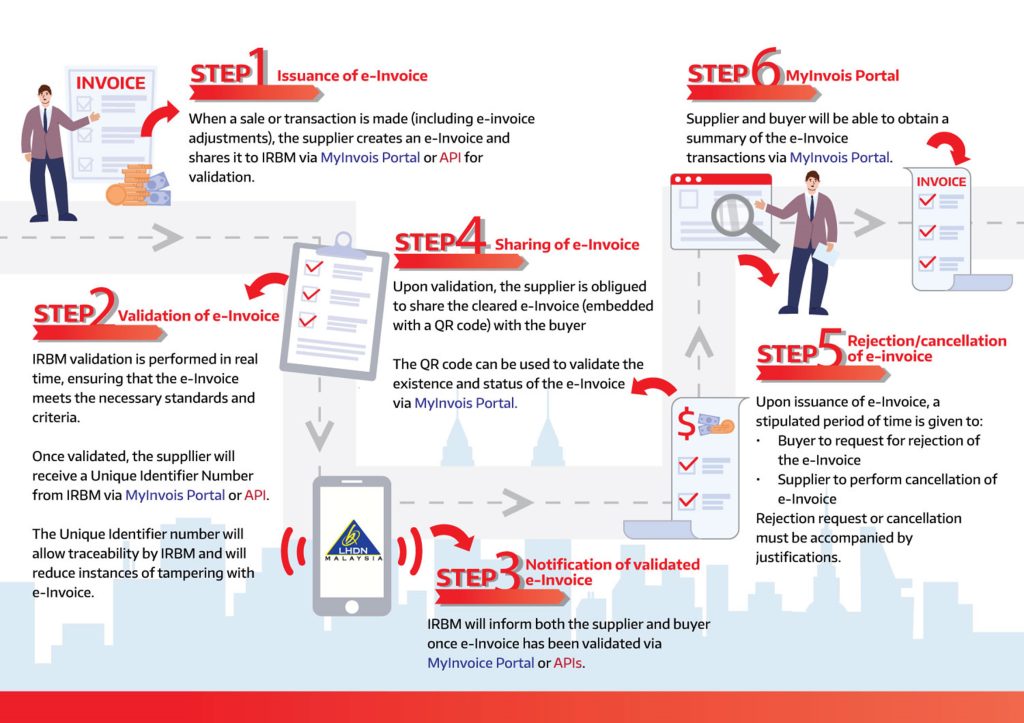
How e-Invoice actually works?

The e-invoice workflow

So how does the whole process of sending and receiving of e-Invoice is like and how long does it take for the validation process?

While it involves a series of complex procedures to ensure a safe digital transaction between supplier and buyer, most of the processes will be conducted within the system, and does not require user’s intervention, and for the validation process, according to LHDN, it will be conducted electronically, which can be done instantly or near-instantly.

Step 1: Issuance of e-Invoice.
The whole e-invoice process begins when a sale and or transaction is made (including e-invoice adjustments), which the supplier or sender create and e-Invoice to share to IRBM via Myinvoice Portal or API for validation. For accounting solution such as AutoCount, this feature is connected through API, by including e-Invoice within our system, users can have a more complete and automated invoicing process, without the need of accessing portal often to send and receive invoices.

Step 2: Validation of e-Invoice.
As the submitted data needs to be validate before release, to ensure the e-Invoice meets the necessary standards and criteria, and according to info provided by LHDN, the validation process by IRBM is in real time or near-instantly.

After the validation process, the supplier will receive a Unique Identifier Number from IRBM within the platform they operates on, and the number will allow IRBM to trace as to reduce instances of tampering with e-Invoice, further strengthen the transaction’s safety and transparency.

Step 3: Notification of validated e-Invoice.
After e-Invoice validation, IRBM will notify both supplier and buyer, either in MyInvoice Portal or APIs.

Step 4: Sharing of e-Invoice.
Upon validation, the supplier is obliqued to share the cleared e-Invoice with the buyer, with a QR code embedded within, which the purpose is to validate the existence of the e-invoice by enablling checking or view in official MyInvois portal.

Step 5: Rejection/Cancellation of e-Invoice.
After the e-Invoice has been issued, a stipulated period of time is given, to allow buyer to request for rejection of the invoice or supplier to cancel the e-Invoice in the process. In this stage, any rejection or cancellation request must be accompanied by justifications.

Step 6: MyInvois Portal.
While there might seems like there are a series of complex procedures involved to send and share invoices, but worry not, with solution such as AutoCount, the e-Invoice feature will be embedded within the system, which users only have to select or enter some basic detail to generate invoices, and let the system automates the rest while keeping you updated, integrating official e-Invoicing within the system also maintain a better data integrity, accuraccy and safety.

LHDN e-Invoice Implementation Updates in Malaysian Budget 2024

A revision to the new e-Invoice implementation timeline for businesses has been announced during the Malaysian Budget 2024, with an update of the postponement of the start date and a shorter target timeframe for full implementation for every taxpayer.

The updated detailed timeline is as follows:

  • 1 August 2024: Implement on taxpayers with an annual turnover of RM100 million and above.
  • 1 January 2025: Implementation towards taxpayers with an annual turnover of RM25 million to RM100 million.
  • 1 July 2025: To achieve full and comprehensive implementation on other remaining taxpayers.